Heathkit Manuals: A Comprehensive Guide
Heathkit pioneered “do-it-yourself” electronics, and their manuals were central to the experience, guiding builders through assembly and troubleshooting of diverse kits.
Historical Context of Heathkit
Heathkit emerged in the post-World War II era, a time of burgeoning interest in electronics but limited accessibility for hobbyists. Founded by Edward S. Heath in 1947, the company initially focused on selling surplus electronic parts. Recognizing a gap in the market, Heathkit transitioned to offering kits – disassembled electronic equipment accompanied by detailed manuals.
This innovative approach democratized electronics, allowing individuals to build and learn about complex devices at a fraction of the cost of pre-assembled units. The manuals weren’t merely assembly instructions; they were educational tools, fostering a community of builders and promoting self-reliance. Early manuals reflected a pragmatic, engineering-focused style, prioritizing clarity and functionality.
The company’s success mirrored the growth of the hobbyist electronics movement, and the manuals became synonymous with the Heathkit brand, representing a commitment to hands-on learning and accessible technology.
The Rise and Fall of Heathkit Corporation
Heathkit’s rise coincided with the boom in consumer electronics during the 1950s-70s. The detailed manuals were a key differentiator, enabling widespread adoption of their kits. As integrated circuits became prevalent, the complexity of electronics increased, and the manuals evolved to accommodate these changes, sometimes becoming more challenging for novice builders.
However, the emergence of affordable, pre-assembled electronics from overseas manufacturers in the 1980s began to erode Heathkit’s market share. The time investment required for kit building, even with the manuals, became less appealing to many consumers. Several ownership changes followed, and the company struggled to adapt.
Despite attempts to diversify, Heathkit eventually filed for bankruptcy in the early 1990s. While the brand has been revived intermittently, it never regained its former prominence, though the legacy of its manuals and DIY ethos endures.
Heathkit’s Educational Philosophy
Heathkit wasn’t simply selling electronics; they were promoting a philosophy of hands-on learning. The manuals were deliberately designed to teach electronics principles alongside the building process. They weren’t just step-by-step instructions, but a form of self-paced education. Builders weren’t merely assembling a device; they were gaining a fundamental understanding of how it worked.
This approach resonated with a generation eager to understand the technology surrounding them. The manuals fostered problem-solving skills, encouraging users to diagnose and repair issues independently. This emphasis on self-reliance and technical competence was central to Heathkit’s brand identity.
The company believed that building something yourself instilled a greater sense of ownership and appreciation for the technology, a value that continues to appeal to enthusiasts today.

Types of Heathkit Manuals
Heathkit produced several manual types, including assembly guides, detailed schematics, comprehensive parts lists, and focused troubleshooting resources for their diverse electronic kits.
Assembly Manuals: Core Documentation
Heathkit assembly manuals were the cornerstone of the DIY experience, meticulously guiding builders through each step of kit construction. These weren’t simply instruction sheets; they were thoughtfully designed educational tools. They featured detailed, step-by-step instructions, often accompanied by clear diagrams illustrating component placement and soldering techniques.

The manuals progressively built complexity, starting with basic assembly and moving towards more intricate wiring and adjustments. They often included explanations of the underlying principles of operation, fostering a deeper understanding of the electronics involved. For beginners, the GR-152 Explorer AM Radio manual offered a gentle introduction to soldering, while more advanced kits demanded greater skill and precision. These manuals weren’t just about how to build something, but also why it worked.
Schematic Diagrams: Understanding the Circuits
Heathkit manuals invariably included detailed schematic diagrams, essential for understanding the internal workings of each kit; These weren’t merely visual representations of connections; they were roadmaps to the electronic heart of the device. They allowed builders to trace signal paths, identify components, and grasp the functional relationships within the circuit.
Understanding these diagrams was crucial for troubleshooting, modification, or even designing related projects. Heathkit’s approach encouraged users to move beyond simply following instructions and to actively engage with the underlying electronics. The diagrams used standardized symbols, allowing builders to apply their knowledge across different kits and electronic systems. Mastering schematic interpretation was a key skill fostered by the Heathkit experience, empowering enthusiasts to become more than just assemblers;
Parts Lists: Identifying Components
Heathkit manuals featured comprehensive parts lists, meticulously detailing every component required for assembly. These lists weren’t simply inventories; they were learning tools. Each part was typically identified by a unique Heathkit part number, alongside a description and often, a visual representation. This encouraged builders to recognize components – resistors, capacitors, transistors – by their physical appearance and electrical characteristics.
The parts lists also served as a crucial reference during troubleshooting. If a kit malfunctioned, the list helped pinpoint potentially faulty components. Furthermore, they were invaluable for sourcing replacement parts, even years after the original kit was built. Heathkit’s detailed approach ensured that builders could not only assemble the kit but also understand what they were assembling, fostering a deeper understanding of electronics.
Troubleshooting Guides: Diagnosing Issues
Heathkit manuals didn’t just explain how to build a kit; they prepared builders for when things inevitably went wrong. Troubleshooting guides were a cornerstone of this support, offering systematic approaches to diagnosing and resolving common issues. These sections often began with a flowchart, guiding users through a series of tests to isolate the problem area.
Voltage checks at specific points in the circuit were frequently included, alongside expected values. The manuals encouraged a logical, step-by-step process, emphasizing the importance of careful observation and methodical testing. They also cautioned against assumptions, prompting builders to verify component functionality before replacing them. This emphasis on problem-solving skills was a key element of the Heathkit educational philosophy, empowering builders to become self-reliant electronics technicians.
Locating Heathkit Manuals
Finding original Heathkit manuals can be challenging, but online archives, forums, third-party repositories, and auction sites offer potential sources for these documents.
Official Heathkit Archives and Websites
Unfortunately, a comprehensive, officially maintained archive of all Heathkit manuals directly from the original corporation is currently unavailable. The Heathkit brand has changed hands several times, and consistent digital preservation wasn’t always prioritized. However, dedicated enthusiasts have stepped in to fill the gap. Several websites, often run by vintage electronics hobbyists, attempt to consolidate available manuals, schematics, and related documentation.
These resources frequently rely on scanned copies of original manuals contributed by collectors. While not always complete or perfectly organized, they represent the best centralized efforts to preserve this valuable information. Checking enthusiast forums (discussed elsewhere) often reveals links to lesser-known archival projects. Remember to verify the accuracy of any downloaded manual against known specifications when possible, as scanning errors can occur.
Online Forums and Communities
Heathkit owners and enthusiasts have cultivated vibrant online communities, serving as invaluable resources for locating manuals and sharing knowledge. Forums dedicated to vintage electronics, radio restoration, and specifically Heathkit products are brimming with discussions, scanned manuals, and helpful advice. These platforms often host dedicated threads for manual requests, where members can assist in locating hard-to-find documentation.
Beyond direct manual sharing, these communities offer expertise in interpreting schematics, troubleshooting issues, and identifying components. Experienced builders frequently contribute their knowledge, assisting newcomers with their projects. Searching forum archives can reveal solutions to common problems and provide insights into specific Heathkit kits. Active participation and respectful engagement are key to benefiting from these collaborative environments.
Third-Party Manual Repositories
Numerous websites specialize in archiving and distributing vintage electronics manuals, including a substantial collection of Heathkit documentation. These repositories, often created and maintained by dedicated hobbyists, offer a convenient alternative to official sources or online forums. Many provide searchable databases, allowing users to quickly locate manuals based on kit number or component type.
While generally reliable, it’s crucial to verify the accuracy and completeness of manuals sourced from third-party sites. Cross-referencing with other sources, such as forum discussions or official documentation when available, is recommended. Some repositories may offer manuals in various formats, including PDF, scanned images, or even text-based versions. Always exercise caution when downloading files from unfamiliar sources and scan for potential malware.
eBay and Auction Sites
eBay and other online auction platforms frequently feature listings for original Heathkit manuals, both individually and as part of larger lots. These can be a valuable resource for acquiring hard-to-find documentation, particularly for older or less common kits. However, prices can vary significantly depending on the rarity, condition, and demand for the specific manual.
Carefully examine the listing description and photos before bidding or purchasing. Assess the manual’s condition – look for tears, stains, or missing pages. Consider the seller’s reputation and feedback. Be aware that shipping costs can add to the overall expense. While convenient, auction sites require diligence to ensure you’re getting a genuine, usable manual at a fair price. Patience and careful searching often yield the best results.

Decoding Heathkit Manuals
Heathkit manuals utilized specific notation and symbols; understanding these is crucial for successful assembly, interpreting schematics, and effective troubleshooting of electronic kits.
Understanding the Notation and Symbols
Heathkit manuals employed a distinct system of notation and symbols to convey complex electronic information concisely. Resistors were typically indicated with a zig-zag line, their value denoted in ohms (Ω), kilohms (kΩ), or megohms (MΩ). Capacitors were represented by two parallel lines, with capacitance specified in farads (F), microfarads (µF), or picofarads (pF).
Transistors and diodes had specific graphical representations based on their type (NPN, PNP, etc.). Wire gauge was often indicated numerically, corresponding to the American Wire Gauge (AWG) standard. Schematic symbols for integrated circuits (ICs) varied, but generally included a rectangular box with pin numbers.
Understanding these conventions is paramount; misinterpreting a symbol could lead to incorrect component placement or wiring, potentially damaging the kit. Careful study of the manual’s introductory sections, which usually included a key to the symbols, is highly recommended before commencing assembly.
Interpreting Schematic Diagrams
Heathkit schematic diagrams are foundational to understanding kit operation and troubleshooting. They represent the electronic circuit using standardized symbols, illustrating component connections and signal flow. A schematic isn’t a physical layout; component placement differs in the actual build.
Key to interpretation is tracing the signal path, often starting from power sources and moving through amplifying or processing stages. Ground symbols (typically a series of descending lines) indicate common reference points. Understanding voltage levels and polarity is crucial.
Schematics often include test points, allowing voltage measurements to verify circuit functionality. Learning to “read” a schematic – identifying components, their interconnections, and signal pathways – unlocks the ability to diagnose and repair issues independently, maximizing the learning experience.
Following Assembly Instructions
Heathkit assembly manuals are meticulously sequenced, guiding builders step-by-step through the construction process. Each step typically details component placement, wiring connections, and soldering techniques. Careful adherence to the order is paramount; skipping steps can lead to errors and rework.

Pay close attention to component orientation – resistors have polarity, and transistors must be correctly aligned. The manuals often feature detailed illustrations, clarifying component placement and wiring. Double-check each connection before soldering, ensuring accuracy.
Heathkit encouraged a methodical approach, emphasizing neatness and organization. Proper technique minimizes errors and enhances the final product’s reliability. Patience and attention to detail are key to a successful build, fostering a sense of accomplishment.

Popular Heathkit Kits and Their Manuals
Heathkit offered iconic kits like the GR-152 radio, GC-1006 clock, and pioneering computer kits, each accompanied by detailed manuals for successful assembly.
The GR-152 Explorer AM Radio
The Heathkit GR-152 Explorer AM Radio represents an excellent entry point into the world of electronics and kit building, and its manual reflects this introductory focus. Described as a solder version, it gently introduces surface-mount soldering with only a few components requiring this technique, making it accessible for beginners. The manual meticulously guides builders through each step, detailing component placement and soldering procedures for both through-hole and surface-mount parts.
Notably, Heathkit also offered a no-solder version, the GR-150, but the GR-152’s manual provides a valuable learning experience in basic soldering skills. The manual isn’t just an assembly guide; it embodies Heathkit’s educational philosophy, fostering understanding of radio circuitry and encouraging hands-on learning. It’s a testament to Heathkit’s commitment to empowering individuals to build and understand technology.
The GC-1006 Most Reliable Clock
The Heathkit GC-1006 “Most Reliable Clock” manual exemplifies the company’s dedication to clear, concise documentation, even for seemingly simple kits. This manual details the assembly of a clock designed for global usability, acknowledging the need for a country-specific AC power adapter. It carefully illustrates component placement and wiring, ensuring builders can construct a functional and accurate timekeeping device.
Beyond basic assembly, the manual likely includes troubleshooting tips and explanations of the clock’s circuitry. Heathkit even offered a clear top panel upgrade kit, with corresponding instructions potentially found within supplemental documentation or revisions of the original manual. The availability of themed t-shirts alongside the kit highlights Heathkit’s branding and community engagement, while the manual remains the core resource for successful construction.
Heathkit Computer Kits (e.g., H-11, H-19)
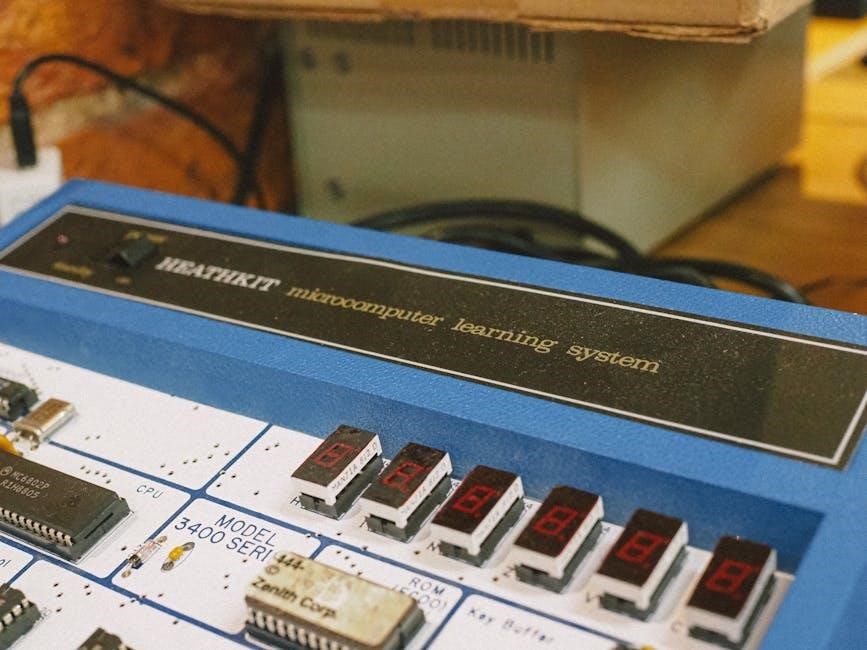
Heathkit’s foray into computer kits, like the H-11 and H-19, demanded exceptionally detailed manuals. These weren’t simply assembly guides; they were introductions to digital logic, microprocessors, and programming. The manuals meticulously documented the construction of the computer, often requiring significant soldering skills and a solid understanding of electronics. They included comprehensive schematics, parts lists, and troubleshooting sections to aid builders through the complex process.
These manuals often served as educational tools, enabling users to learn about computer architecture while building a functional machine. The H-11 manual, for example, would guide users through building a working microcontroller computer capable of controlling robots or managing sensors. Heathkit provided the knowledge and the components, empowering enthusiasts to enter the world of computing.
Heathkit Audio Equipment (e.g., Amplifiers, Receivers)
Heathkit’s audio equipment manuals, covering amplifiers and receivers, were renowned for their clarity and thoroughness. These guides weren’t just about connecting wires; they detailed the principles of audio circuitry, explaining the function of each component and stage. Manuals included detailed schematic diagrams, allowing enthusiasts to understand signal flow and troubleshoot potential issues. Parts lists were meticulously organized, aiding in component identification and replacement.
Building a Heathkit amplifier or receiver was a learning experience, and the manuals facilitated that process. They often included alignment procedures to optimize performance and detailed explanations of common audio concepts. These manuals empowered hobbyists to build high-quality audio equipment and gain a deeper understanding of sound reproduction, fostering a dedicated community of builders and listeners.
Preserving and Restoring Manuals
Heathkit manuals benefit from digital scanning for archiving, alongside careful physical restoration techniques to combat age and ensure longevity for future generations.
Digital Scanning and Archiving
Digital preservation of Heathkit manuals is crucial, given their age and potential fragility. High-resolution scanning, ideally at 300-600 DPI, captures detail effectively. PDF format is preferred for accessibility and compatibility, allowing for searchable text if OCR (Optical Character Recognition) is applied.
Archiving should involve a robust file naming convention and metadata tagging – including kit number, manual type (assembly, schematic, etc.), and date. Cloud storage or multiple backups on external drives safeguard against data loss.
Online repositories benefit immensely from community contributions, creating a collaborative archive. Consider sharing scans on dedicated forums or websites specializing in vintage electronics. Properly archived digital copies ensure these valuable resources remain accessible for restoration projects and historical research for years to come.
Physical Restoration Techniques
Restoring original Heathkit manuals requires careful handling. Gently remove any loose debris or surface dirt with a soft brush. Avoid harsh chemicals; use a slightly damp (not wet!) cloth for cleaning. For torn pages, archival-quality repair tape is preferable to standard adhesive.
Loose bindings can sometimes be carefully re-glued using acid-free bookbinding adhesive. If the cover is damaged, consider creating a protective mylar sleeve. Deacidification sprays can help slow down paper deterioration, but test on an inconspicuous area first.
Prioritize preservation over aggressive restoration; the goal is to stabilize the manual, not make it appear new. Document any restoration work performed, as it adds to the manual’s history and value for collectors and enthusiasts.
Copyright Considerations
Heathkit manuals, while vintage, may still be subject to copyright. While many copyrights have likely lapsed, especially for manuals published decades ago, it’s crucial to exercise caution when reproducing or distributing them. Public domain status isn’t automatic; it depends on publication date and renewal status.
Digitizing and sharing manuals for personal use is generally considered fair use. However, selling copies or creating derivative works without permission could infringe on existing copyrights. Researching the specific manual’s publication date and copyright records is advisable before widespread distribution.
Attributing Heathkit as the original creator is always good practice. Respecting intellectual property rights ensures continued access to these valuable resources for future generations of electronics enthusiasts and restorers.
The Value of Heathkit Manuals Today

Heathkit manuals remain invaluable for restoration, education, and enthusiasts, providing essential schematics, assembly guidance, and troubleshooting steps for vintage electronics.
For Restoration Projects
Heathkit manuals are absolutely critical when undertaking the restoration of vintage electronic equipment. These documents provide the original construction details, allowing restorers to accurately rebuild circuits and replace components. Without a manual, identifying parts and understanding the intended functionality becomes significantly more challenging, potentially leading to incorrect repairs or irreversible damage.
The schematics within these manuals are essential for tracing signals and diagnosing faults. Parts lists ensure the correct replacements are sourced, maintaining the original specifications. Even for experienced technicians, a Heathkit manual offers a unique insight into the design philosophy and construction techniques of the era, aiding in a faithful and respectful restoration; They are the cornerstone of bringing these classic kits back to life.
For Educational Purposes
Heathkit manuals serve as invaluable educational resources for aspiring electronics enthusiasts and students. They offer a practical, hands-on learning experience, allowing individuals to understand electronic theory by building and troubleshooting real circuits. Unlike passively studying textbooks, assembling a Heathkit kit reinforces concepts like component identification, soldering techniques, and circuit operation.
The step-by-step assembly instructions and detailed schematics provide a clear pathway to understanding complex systems. Even modern learners can benefit from the deliberate, methodical approach encouraged by these kits. Studying these manuals fosters problem-solving skills and a deeper appreciation for the fundamentals of electronics, making them a timeless tool for self-education and skill development.
For Vintage Electronics Enthusiasts
For collectors and enthusiasts of vintage electronics, Heathkit manuals are indispensable. They represent a crucial piece of the hobby, providing the necessary documentation to restore and maintain these classic kits to their original working condition. Locating the correct manual can be the difference between a successful restoration and a frustrating project.
These manuals aren’t just technical guides; they’re historical artifacts, offering a glimpse into the era of DIY electronics and the ingenuity of Heathkit’s designs. They connect enthusiasts to a community of builders and restorers, fostering a shared passion for preserving these iconic kits. The manuals themselves often become collectible items, adding to the overall value and enjoyment of the hobby.